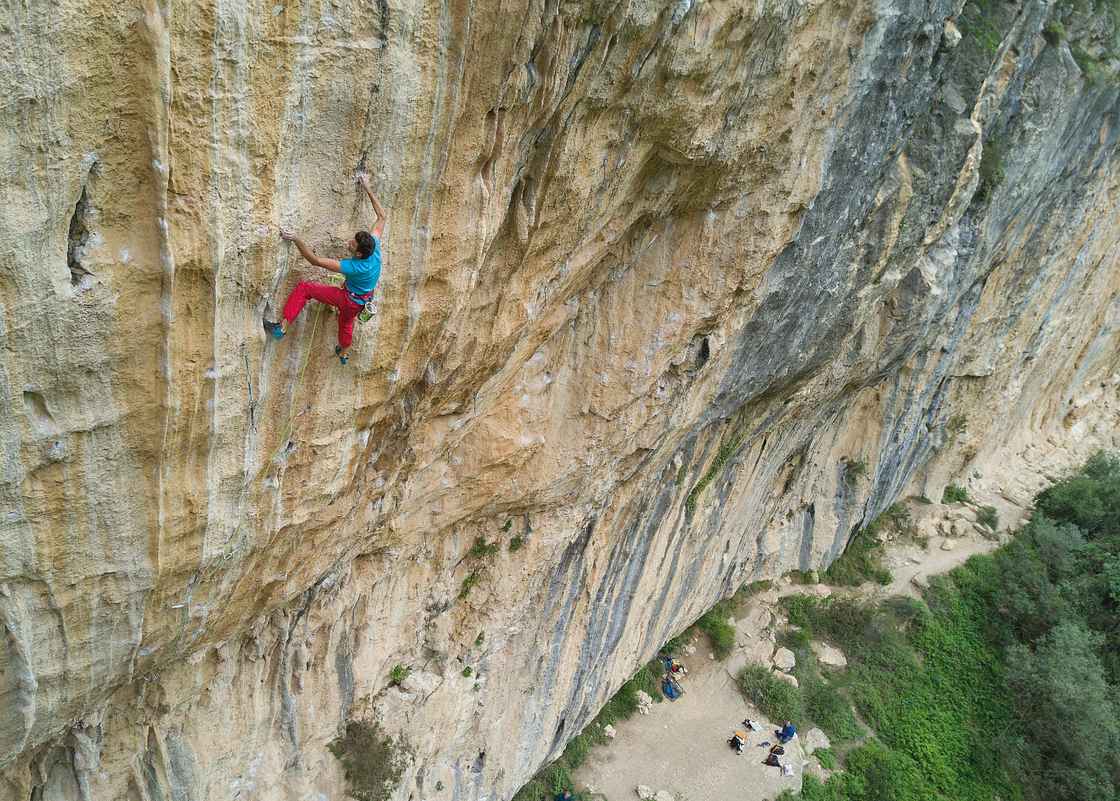
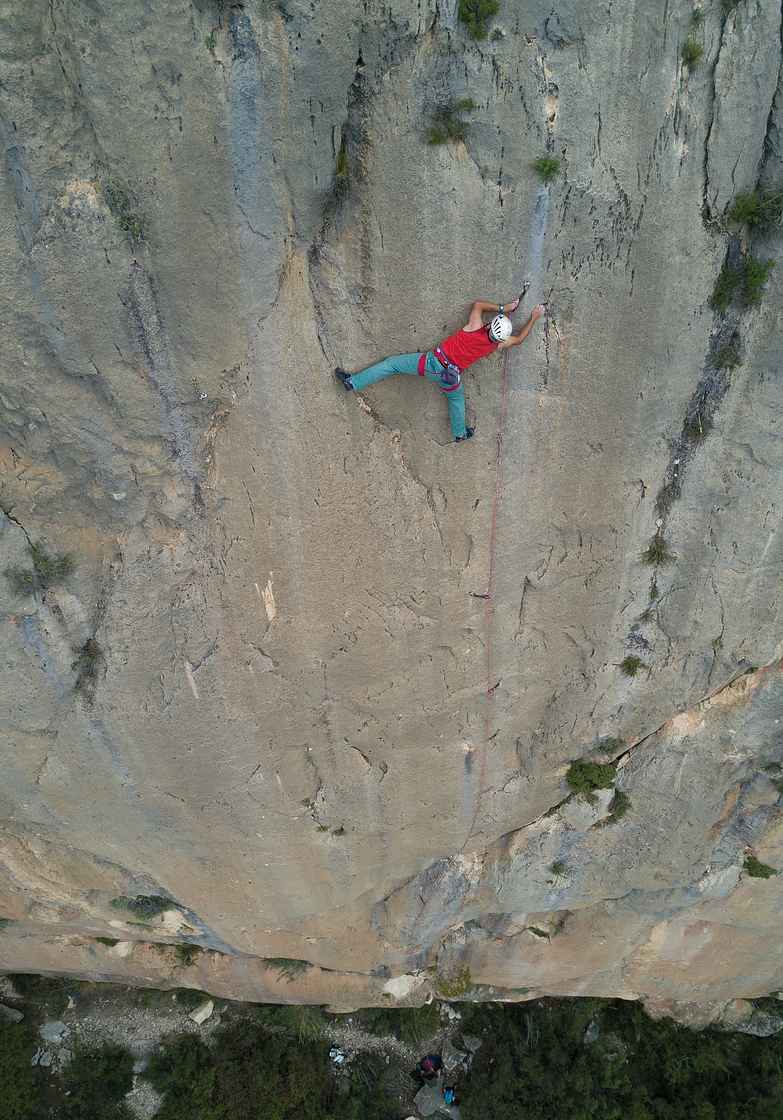
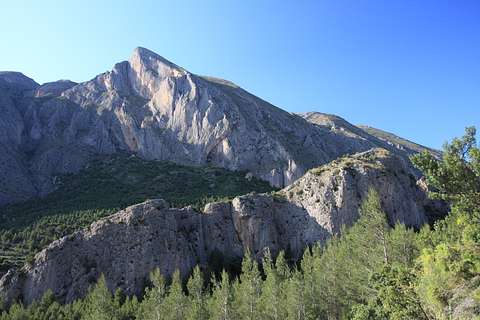
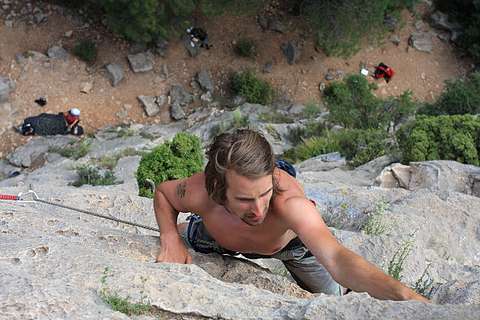
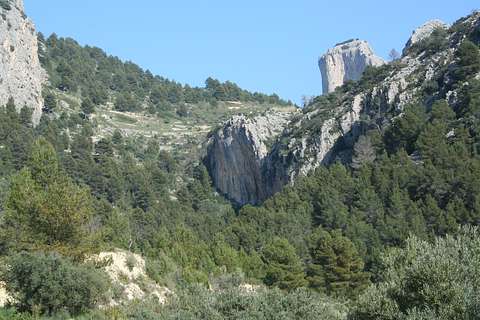
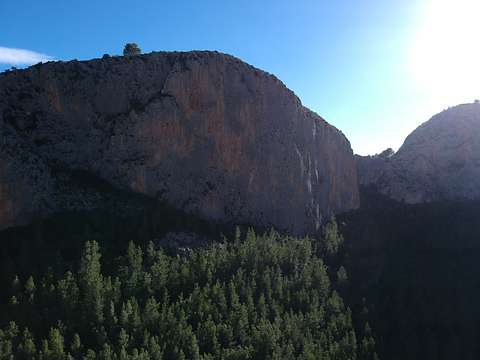
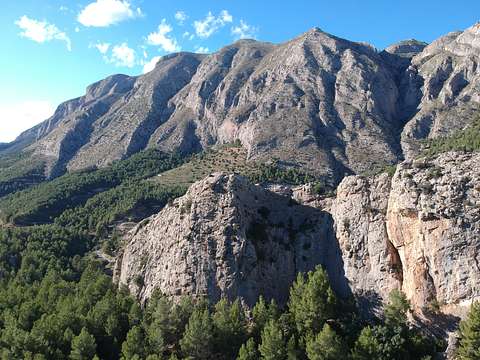
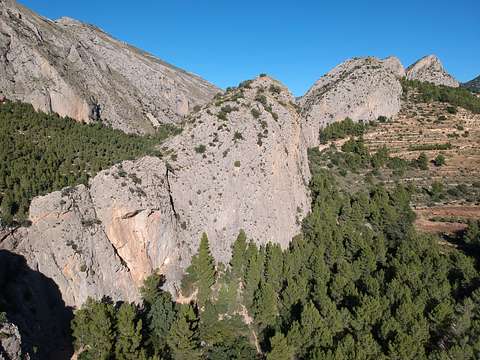
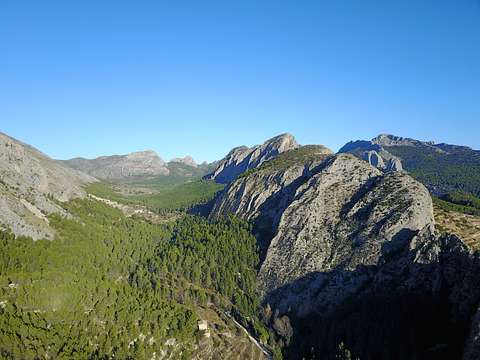
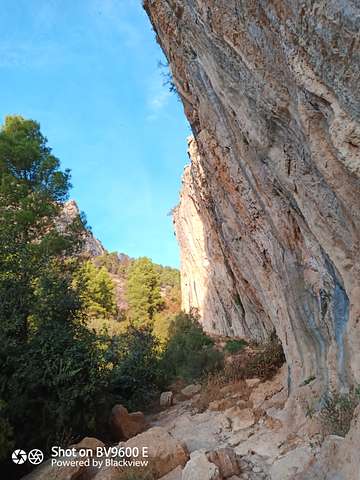
Due to its history, number of sectors, number of routes, rock quality and variety of climbing styles, Sella is, without any doubt, the undisputed queen school in the province of Alicante. Located in the heart of the Sierra de Aitana and divided between the municipalities of Sella and Benimantel, this area has the most extensive and voluminous rocky complex in all of Costa Blanca, with an abrupt orography riddled with valleys, crests and ravines, giving rise to such quantity of sectors, that an exclusive guide would be necessary to include them all in a single publication. From our side, here we have made a selection of the most important walls, with more than 470 routes divided into four large areas, which we will now detail. In the first place, and at the foot of one of the most emblematic walls of Alicante, you can find the Peñón del Divino area. Here, you can find the overhangs of the Cueva del Divino and the demanding technical vertical walls of the CP10M and El Elefante. Secondly, we tackle all the sectors of the Peña de la Moleta, both the classic walls near the refuge and the most recent ones located in the upper part of this rocky strip. The third zone appears just in front of us, where the imposing walls of Rosalía and Tafarmaig emerge, great references of the "Old school" climbing, with highly technical plates, quite some run-outs and routes of up to 5 pitches and 100 meters long. Last, the quiet and remote Goleró area brings us, in the VIPS and Wild Side sectors, the largest group of hard routes in the entire Costa Blanca, with almost a hundred lines with more than half of them reaching the eighth grade.
Divino area:
In the CP10M sector, named after one of its first routes (Cómeme la Polla a las 10 de la Mañana), you will find excellent vertical walls of sixth and seventh grade reaching 30 meters long and a limestone rock of such quality that sometimes reminds us of the mythical French Verdon. For his part and, located just after the previous one, the imposing rock shield of the Elephant sector emerges, one of the most spectacular in all of Sella. It is a grandiose wall where smooth sheets of excellent limestone alternate with surprising parts full of tufas, reaching 80 meters at its highest part and giving rise to twenty routes. Its climbing, very technical and fingery, hardly gives any option for people with a low level. Last, but not least, please note that this may be one of the quietest and least frequented areas of Sella, so here, the visitor will ensure a stay away from noise and large crowds, in addition to enjoying enviable views in an environment of absolute beauty.
La Moleta area:
La Moleta is a long rocky ridge where the most classic and popular sectors of the Sella crag are located. It starts right in front of the refuge, drawing an almost perfect silhouette of a rhino, a fact that gives name to most of the first sectors, and it gradually ascends until reaching, hundreds of meters after its start, the last vertical walls before reaching the rural part of Sirventa. Except for the first routes, located in short and explosive overhangs, all sectors are virtually developed on vertical walls tending to very light slabs, giving rise to highly technical routes where you will find a wide range of routes from the III to 8b+, with fifth-, sixth- and seventh-grade routes prevailing, and routes ranging from the 8 meters of its shortest curbs, to the more than 50 meters of its highest lines.
Rosalía area:
Well visible from the town of Sella and with a length of almost 2 kilometers, the rocky ridge on which the great walls of Rosalía and Tafarmaig are located, harbors one of the most daring climbing scenarios in the entire Marina Baja region. Its enormous walls, which can reach 100 meters tall, offer a wide range of possibilities, from single-length sport climbing routes to large multi-pitch routes with even five pitches, and a multitude of classic lines where you might have to use more than just quickdraws. Famous for the commitment needed on their routes and for the technical and demanding style of its movements, its extraordinary limestone rock has hardly been altered over the years. These might be the reasons why, despite the high quality of its climbs, these crags have never gathered large crowds. It could be said that 6b+ is the minimum essential grade to being able to start enjoying the more than 70 sport climbing routes that you will find here, most of them located between the sixth and seventh grade. From left to right, just in front of the Peña de la Moleta, the great Rosalía sector emerges, with 53 high-quality routes, an extraordinary gray limestone and an “old school” style not suitable for commercial climbers. Dividing the walls of Rosalía and Tafarmaig you will find the Collado sector. Inaugurated in the 90s with the occasion of a competition, you will enjoy a very quiet and discreet environment, with 16 sport climbing lines that reach up to 8a+.
El Goleró area:
Located in a quiet and remote valley 3 kilometers away from the refuge, the Goleró area is the most isolated and solitary of all Sella, and it is presented, with its VIPS and Wild Side sectors, as the place with the highest concentration of hard routes throughout the Costa Blanca. Surrounded by a landscape of great beauty, here you will find almost a hundred routes where more than half reach the eighth grade, so without any doubt, it is a terrain reserved for very-high-level climbers. The VIPS is made up of a long overhanging wall that offers almost twenty quite bouldery lines. Its left part is the one that overhangs the most, hosting some of the hardest routes in all of Sella, while the right wing gives way to a slightly more vertical area where you will find demanding seventh grade vertical lines. A few minutes from here and with a totally opposite orientation, there is the spectacular Wild Side sector. Located in a corner of gloomy and thick vegetation, this overhanging wall of about 150 meters wide could be described as the jewel in the crown, and not only of the whole, but Sella crag, but the entire Costa Blanca. Contrary to the VIPS, here there are more than 70 routes reaching an average height of about 20 meters and that, on several occasions, exceed 40, resulting in demanding and athletic itineraries dotted with crimps, slopers, pockets and tufas that create a characteristic style only suitable for the fittest climbers. If we add to all this its comfortable belaying spot, a beautiful environment surrounded by wild nature and a privileged orientation that protects it from the sun for most of the year, the result makes the Wild Side one of the best walls in Spain and the clear and indisputable flagship of climbing in Alicante.
Divino area:
It is here where the first climbs of the whole Sella crag took place. These first routes appeared during the 60s and 70s out of the hands of pioneers such as Manolo Pomares, Pedro Notario, Rafa Botella and Montesinos, who conquered the walls of the most important piece of rock in the area, the rock of Divino. These first routes were opened with ancient artificial techniques and in a completely unknown scenario up to that moment. It was already in the 80s when the crag saw its first sport climbing routes. They emerged in “La Sartén”, a forgotten area located to the right of the Divino cave that met all the requirements that climbers of the time were looking for: vertical walls, short routes and excellent quality limestone. Soon after, the nearby walls of the Totxo del Falo and CP10M would also see the birth of some of these first sport climbing lines. This was all the result of the work of a daring group of climbers called Los Petardistes de les Aristes. With a large number of members, most of them from Elche, this gang of fanatic climbers was not only in charge of making the transition from climbing on great walls to the short and demanding curbs of sport climbing, but they were also responsible, together with the alcoyanos, of the creation and evolution of this new discipline imported from the main world references of that moment: Yosemite, France and Germany. Nowadays, the sport climbing sectors of this area have little or nothing to do with those of the early 80s, nowadays totally out of use.The main developer of CP10M is Nacho Sánchez, who continued the work of Les Petardistes during the 90s. Subsequently, and already in the 2010s, other developers in the area would complete the sector, almost doubling the number of existing routes. In El Elefante, the pioneers were Rowland and Mark Edwards, followed again by Nacho Sánchez, who carried out the vast majority of bolting during the 1990s. From 2010 on, Roberto López gave this crag a final boost by bolting some of the hardest routes in the area and rebolting old lines that had fallen into complete oblivion due to their outdated and, at times, dangerously poor protection.
La Moleta area:
Here again we have to talk about Los Petardistes de les Aristes. After their first dabbling with the sport in the sectors near the rock of Divino, in the mid-80s, the natural evolution of the activity would lead them to discover these walls, much more comfortable and accessible than the previous ones, even more considering that at that time, the only way to get to the area was hiking for the more than 4 kilometers that separate it from the town of Sella. Therefore, the group with Fco. Durá "Perleta", David Mora, José M. Soriano "Chunai", Rafa and Paco Llopis, Javier Medrano, Juan and Vicente Toledo, Arturo Uréndez, Chema Ramírez, Juan Carlos "Mecha", José Felix, Juan José Motos, Miguel Muñóz, Jesús Sánchez, Julio Garcés, José Fco. Navarro, Miguel Ángel Bravo, María Otilia Navarro and Manuel Pérez Manresa, began bolting all sectors of the old part of la Moleta, from the Desplomes del refugio to the Final sector. One of the events that would mark a turning point in the evolution, not only of this crag, but of all the climbing in Alicante, would arrive with the opening of the route Comtitapel at the end of the 1980s. Located in the Desplomes del refugio and bolted by Chema Ramírez and Quique Barberá, this 7a route would set a new standard of difficulty and would represent a revolution within the climbing group of the time. The arrival of the 90s would bring with it a lot of new openings, the first competitions in natural rock, both in difficulty and speed, and the appearance of new climbers that little by little would give way to the already established Petardistes. Two of these new figures, José Miguel García and Nacho Sánchez, would take on a leading role in 1993, when they inaugurated a refuge in the old house where the irrigation community kept the motors with which they extracted water from the Font de l'Arc. These new facilities, together with the great opening activity carried out by its regents, would definitively consolidate the area as one of the queen schools of the entire Costa Blanca and would be the gateway for all those climbers coming from far beyond our borders. And then we arrived to the new millennium. The existing sectors had few options for new bolting and many of their routes, besieged year after year, began to show obvious signs of great wear. The area is not left without any visits but it is beginning to be considered as a place of old vertical walls, polished routes and "old school" climbing. But then in 2013 a very relevant event takes place. The farm that owns the land in the upper part of La Moleta changes ownership and, the new owners, who are climbers, far from maintaining the prohibition to climb on those walls, launch themselves, together with their friends, into the massive equipment of all those walls. In this way and thanks to the work of Kris Beigang, Jonathan Emett, Rich Mayfield and Tony Pearson, among others, some 60 new routes emergem that give a deep breath of fresh air to the school and expand and renew its stagnant climbing offer. These new sectors maintain the general trend of the area, with vertical walls of excellent gray limestone, comfortable belaying spots and routes that go from IV to 8a, although the fifth- and sixth-grade clearly predominate. The last few years have brought a resurgence of new equipment in some of the most classic sectors of the school, such as Cajón de los cuartos or el Ojo de Odra, walls where the number of routes has practically been doubled.
Rosalía area:
The history of this area is almost the same as that of its neighboring Moleta. With little prominence on the side of the Petardistes, Nacho Sánchez assumes most of the openings and becomes the main developer of this entire area. Most of the routes appeared in the 90s but, during the following years, new lines did not stop emerging, gradually completing the walls until reaching the current offer. Other prominent actors in this area are José Miguel García, the brothers Juan Carlos and Jesús Romero, Andrés Llorens “Coco”, José M. Anaya and Vicente Gimeno "Pitu".
El Goleró area:
The first routes of VIPS sector date back to 1990 and were the work of the English Mark Edwards. Next, a young Iván Hernández would lead its bolting, creating an authentic laboratory of high difficulty climbing that would culminate in 1996 with the sending of the route Ejecución radical, an 8c+ that remains unrepeated nowadays. From here and despite its quick access and comfortable belaying spot, this area, clearly eclipsed by its neighbor Wild Side, would gradually lose popularity until it became a practically marginal sector. Currently, the VIPS continues to live in the shadow of the Wild Side, but in recent years, in addition to some new openings, it has been clearly renewed thanks to the massive re-bolting that Rubén Denia is carrying out on its walls.The Wild Side history begins in 1992. The VIPS was in full swing and the local climber José Miguel García Fraile begins to make small forays into this wall, at that time totally invaded by vegetation. Little by little, he managed to get to its right wing, and inaugurated the sector with the first routes: Si te dicen que caí and Todos los caminos conducen al romo. The great potential of the area does not take long to attract the attention of other teams, and in a short time, great classics were born, such as Ya somos olímpicos and Ergometría both bolted by José M. García himself, Watermark, by Mark Edwards or La forqueta del diablo and Celia by Pep Ginestar. But the real shock would come with the appearance of the duo formed by Iván Hernández and Agustín Gómez, the most fit climbers of the time. This couple would lead for more than a decade the development of this sector, with continuous openings of the highest level and their corresponding sends (the hardest of that time). In the new millennium, new actors would enter the scene. Miguel Sánchez, José J. González “Kiki”, José M. Anaya or Roberto López, among others, would continue with the opening work until completing, a crag literally full of routes where it will be very difficult to open new lines.