FR
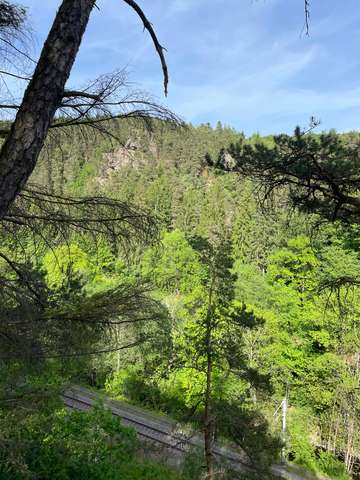
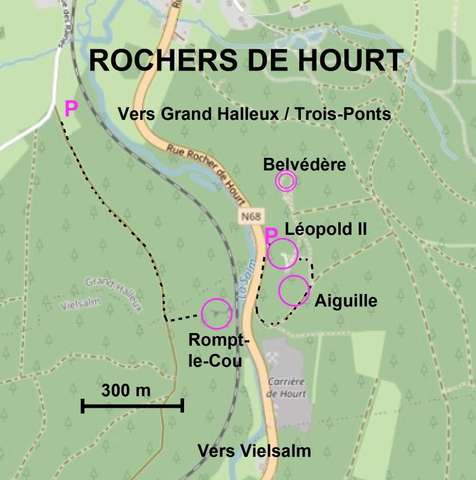
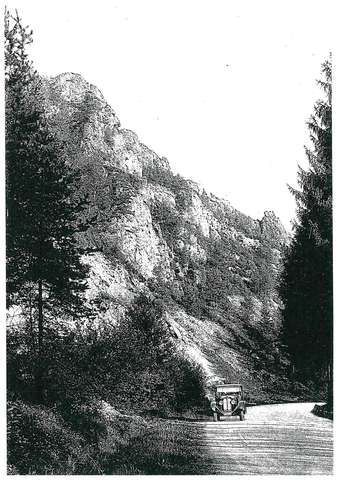
Le rocher Léopold II est peu visible de la route car caché par la forêt. Il fait environ 85 m de hauteur avec 4 ressauts principaux. Sur la crête plus à droite (en regardant du parking) se drese une petite aiguille d'une quinzaine de m de hauteur.
La roche est de la quartzophyllade datant du Tremadocien (env 480 millions d'années) qui a ensuite subi le plissement hercynien (env 350 millions d'années) puis a été érodée. En comparaison, la formation des Alpes s'est produite entre 65 et 2,5 millions d'années.
UK
"Le rocher Léopold II" is barely visible from the roas as it is screened by the forest. It is about 85 m high with four main rochy steps. A small pinnacle (the Needle) about 15 m high stands on the ridge more to the right (looking from the parking).
The rock consists of quartzophillite dating from Tremadocian (approx 480 millions years ago), it subsequently underwent Hercynian folding (approx 350 million years ago) before being eroded. As comparison, the formation of the Alps happened from 65 to 2,5 millions years ago.
FR
Les premiers grimpeurs locaux sont arrivés dans les années 60 avec principalement Marcel Focant qui était sous-officier moniteur éducation physique au 3ème Bataillon des Chasseurs Ardennais caserné à Vielsalm. Il y emmenait les militaires pour des exercices d'escalade et de rappel. Il a aussi beaucoup grimpé avec son beau-frère Jules Libouton. Dans les années 80, les exercices militaires s'estompent peu à peu et il faudra attendre 2017 avant que Bernard Marnette ne redécouvre le massif. Sous son impulsion, le CAB a conclu une conventionavec la commune de Vielsalm en 2021 et par la suite Bernard, seul ou avec des amis, a rééquipé le massif ainsi que celui de "Rompt-le-Cou" de l'autre côté de la Salm.
UK
The first local climbers appeared in the 60's, most notably Marcel Focant who was non-commissionned officer Physical Training Instructor in the 3rd Battallion of Chasseurs Ardennais stationed in Vielsalm. He uses to to take soldiers there for rock climbing and rappelling exercises. He also climbed frequently with his brother-in-law, Jules Libouton. By the 1980s, military exercises gradually ceased, and it was not until 2017 that Bernard Marnette rediscovered the crag. Under his initiative, the CAB signed an agreement with the municipality of Vielsalm in 2021, and Bernard subsequently re-equipped the crag, on its own or with some friends, as well as the "Rompt-le-Cou" site on the other side of the Salm River.