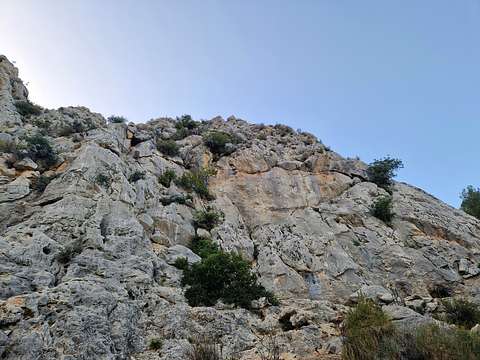
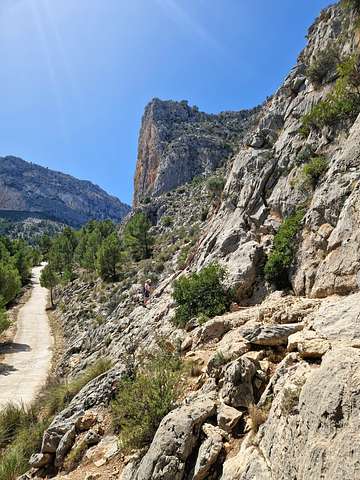
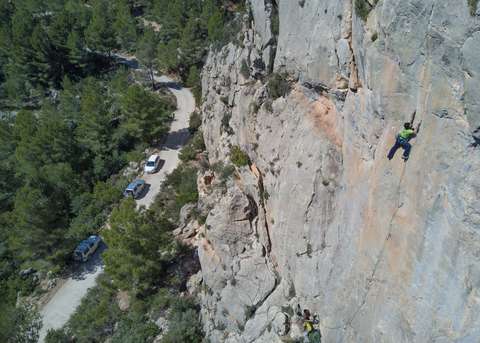
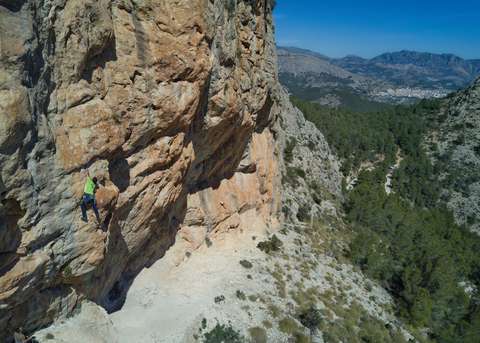
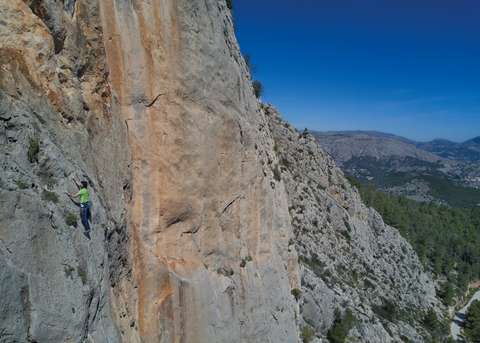
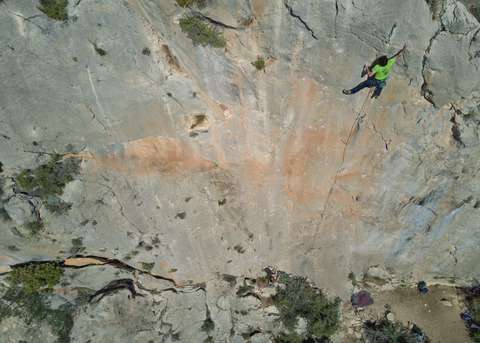
Guarding the right flank of the great Ponoig mountain and a few minutes away from the towns of Polop and La Nucía, the Barranc de Gulapdar offers a great rocky complex that, thanks to its large number of easy routes and convenient access, enjoys a great popularity within the climbing community, especially climbers from abroad. There are several sectors where we can find both short routes and long classic routes and also trad climbing. In this guide, we will only explain the three crags agglutinating the almost one hundred sport climbing routes offered by this school (also, the most famous and frequented in the area). The first of them is the Carretera sector. It is located below the Castellet de Polop and gives us a wide range of routes between IV + and 7c, with a predominance of the sixth grade, the vertical slab and routes that generally do not reach up to 20 meters. The second is known as Echo 1.5. It was designed to teach climbing courses and, therefore, in its two walls you will find fabulous slabs that will rarely exceed the fifth grade. Finally, the base of the Arrán de Batistot, a large rocky triangle over 100 meters high, offers almost thirty short and demanding overhangs where we can face the toughest routes in the school, as well as a handful of impressive vertical lines in the spectacular Placa de la Inmaculada, located just to its right side.
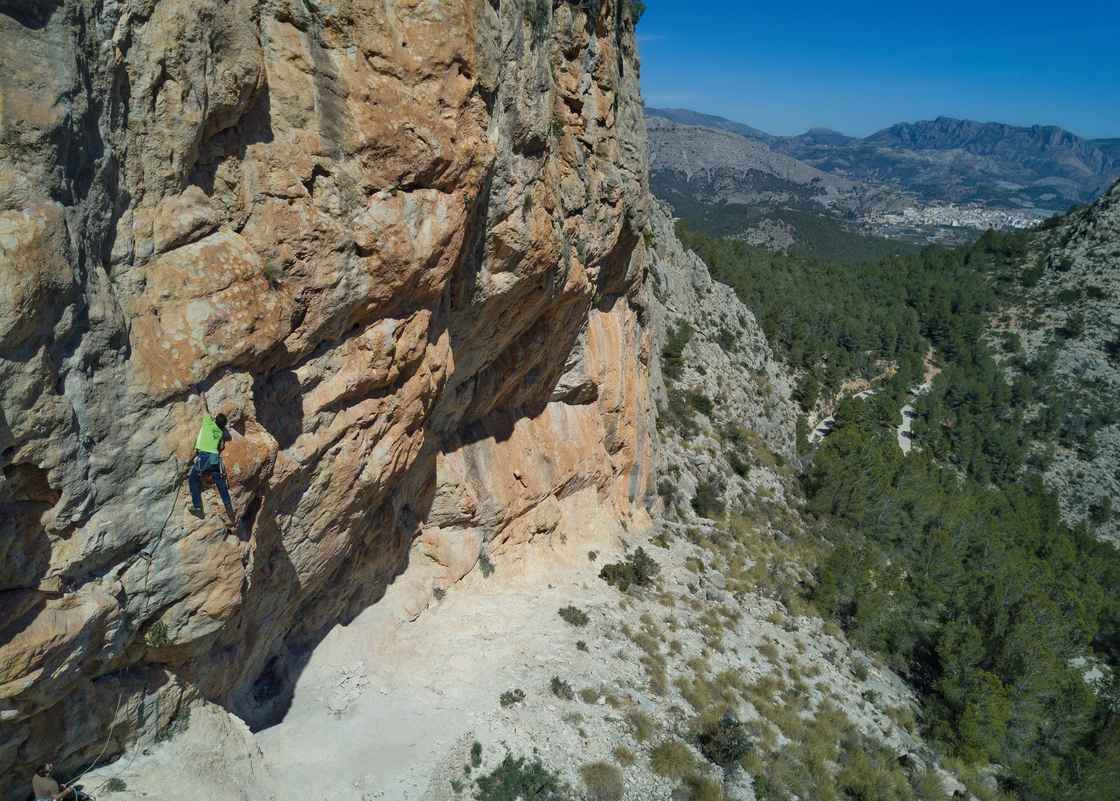
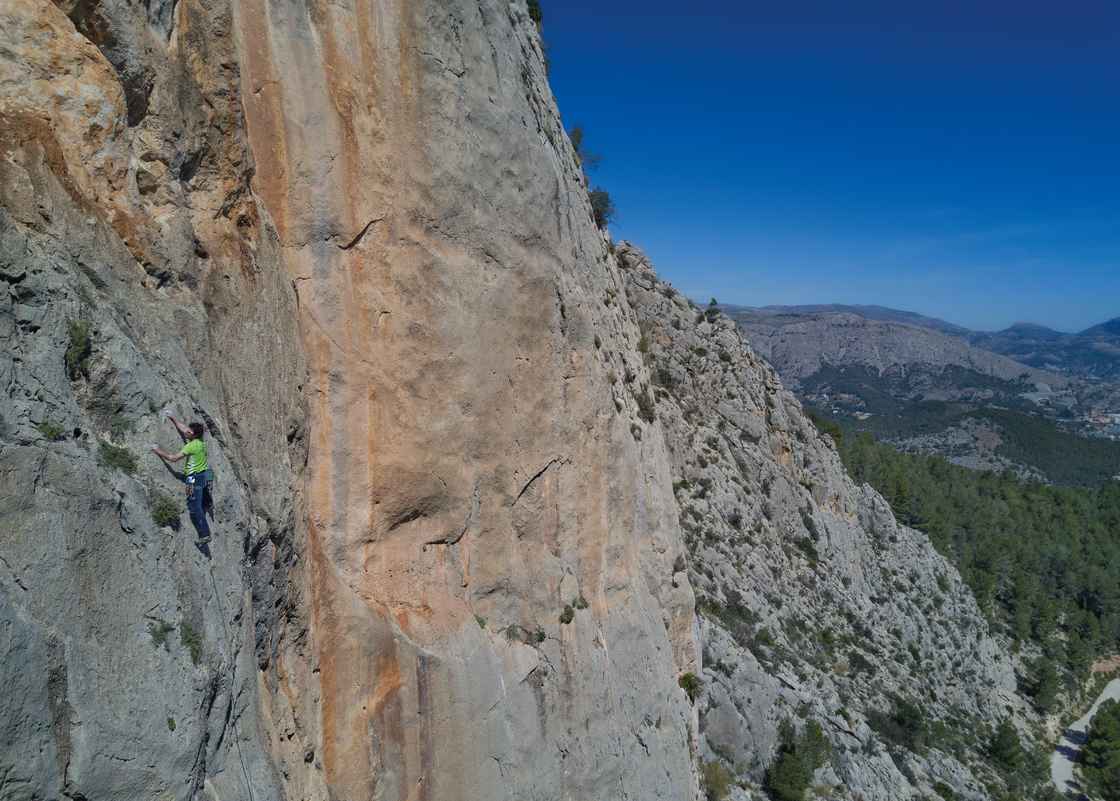
The history of this place begins approximately in the mid-90s. Although it already had some classic routes from the 80s, it could be stated that the bolting on the wall of the ´Carretera de la vía Patas de pollo´, by the local climber Vicente Gimeno "Pitu", would mark in 1996 the beginning of sport climbing in this area. Almost in parallel, Rowland and Mark Edwards began bolting some routes in the sectors of the right side of the Castellet de Polop and, after its completion, they moved to the Arrán de Batistot where they developed a new anchoring system called ENP (Enviromental nut protection), which consisted of an 18mm diameter shell with a groove where a recessed fitting of a certain size to fit in. Once inside, the recessed fitting was rotated, and it was kept inside the shell with the help of a small elastic spring that prevented its accidental rotation. There were several routes bolted with this system, but it did not become very popular among the climber community, and it would soon entail the abandonment of this new device and its subsequent replacement by the classic bolt and bolt hanger anchors. After these events and the completion of the Carretera sector, the local teams, with "Pitu" leading them, entered the overhanging walls of the the Arrán de Batistot, adding new lines and rebolting old ones. Finally, and during the new millennium, Richard Mayfield, in search of a new alternative to the polished vertical slabs of the Cajón de los cuartos sector of Sella, creates the sector Echo 1.5 as a place where he can teach his numerous climbing courses, turning this one in one of the most visited corners of the entire Marina Baja.